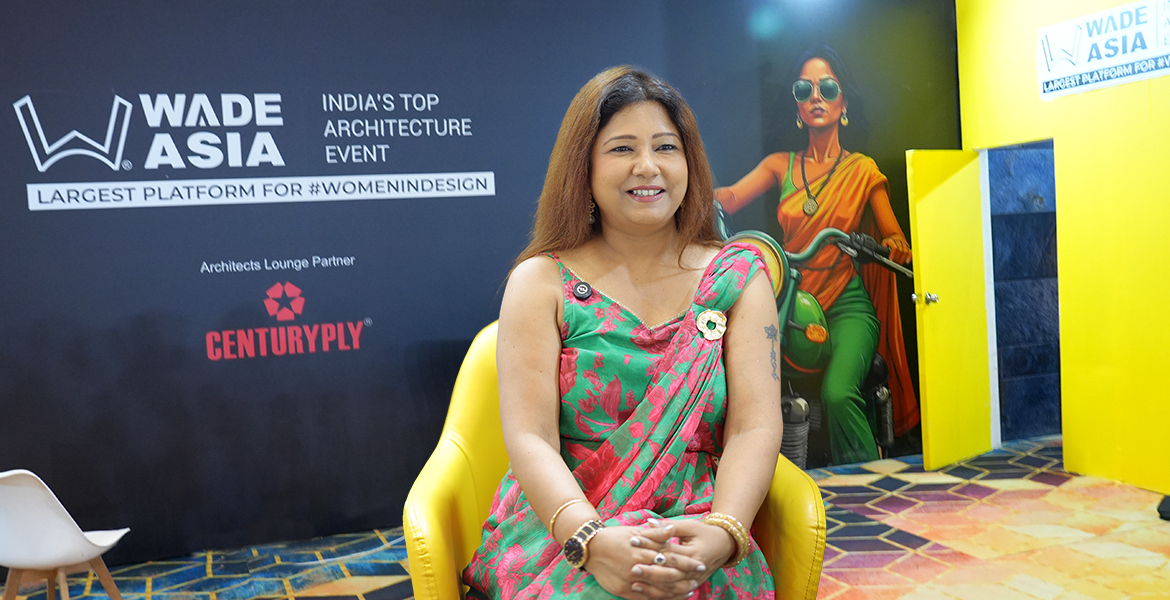
Discover the vision behind THE WADE ASIA as founder Verticaa Dvivedi shares its journey, purpose and future, and how SheBuilds and SheDesigns are creating new opportunities for women across the built environment.
1. How did THE WADE ASIA begin?
THE WADE ASIA began with a very simple observation.
I was already deeply connected with the architecture and design industry through my work in publishing, and I could see that there were so many talented women in the profession — but their visibility and recognition were not always proportional to their contribution.
So in 2016, we started WADE.
But I never wanted WADE to become just another award.
I wanted to create a platform where women could be seen, be heard, be recognised and eventually create opportunities for themselves.
Over the years, THE WADE ASIA grew from an initiative into an ecosystem — awards, competitions, conferences, conversations, networking, business connections and knowledge.
And today, when I look back, I don’t see just the growth of an event. I see the growth of a community.
The real scale of WADE is not the size of the event. It is the number of women whose visibility increased because the platform existed.
2. What does THE WADE ASIA stand for today?
For me, THE WADE ASIA has always stood for three things — visibility, credibility and opportunity.
Visibility means people should know who you are and what you are capable of.
Credibility means your work should be recognised on merit.
And opportunity means that recognition should eventually translate into projects, business, leadership and growth.
Because I don’t believe empowerment should stop at applause.
Applause is wonderful. But opportunity changes lives.
3. What is SheDesigns by THE WADE ASIA?
SheDesigns is the next layer of that journey.
We realised that women didn’t just need a platform to attend. They needed a platform where their work could be seen, evaluated, discussed and recognised.
SheDesigns gives women an opportunity to put their work forward nationally and stand alongside some of the best work in the profession.
But for me, the award is not the end.
The visibility that comes from that recognition can create credibility, new relationships and new opportunities.
So I would put it very simply:
SheDesigns says — look at what she has designed.
4. And what is SheBuilds?
SheBuilds is where the conversation becomes much bigger.
For years we have been asking women, What are you designing?
Now we are asking:
What are you building?
Other than projects & edifices,
Are you building a practice?
Are you building a company?
Are you building a team?
Are you building a brand?
Are you building economic value?
Are you building opportunities for other people?
SheDesigns celebrates the work women create through design.
SheBuilds is about the larger professional and entrepreneurial world that women are building around that talent.
So my simplest definition would be:
SheDesigns says, ‘Look at her work.’ SheBuilds says, ‘Look at what she is building.
5. Why did you feel the need to create SheBuilds after WADE and SheDesigns?
Because if you are serious about building a movement, you have to evolve.
If I am doing in 2026 exactly what I was doing in 2016, then I haven’t built a movement — I have simply repeated an event.
The first chapter was about visibility and recognition.
The next chapter has to be about business, leadership, entrepreneurship and scale.
Women don’t only want to be celebrated anymore.
They want to build larger practices. They want larger projects. They want companies. They want teams. They want financial independence. They want influence.
So the platform has to evolve with the woman.
6. You have taken THE WADE ASIA forward and scaled it enormously. What did you learn about scaling?
The biggest lesson I learnt is that scaling is not about doing more yourself.
In the beginning, entrepreneurship is very personal. You do everything.
You sell, you negotiate, you create, you follow up, you solve problems, you build relationships.
But eventually you realise that if everything depends on you, you haven’t really scaled.
You have simply created a bigger job for yourself.
Scaling requires people, systems, processes, technology, partnerships and delegation.
And the founder’s role has to evolve from being the person who does everything to being the person who builds an organisation that can do great things without depending on her every minute.
7. What does THE WADE ASIA, SheBuilds and SheDesigns mean for brands and building-product companies?
For brands it means entry, connections and market opportunities in projects and buildings created by women in design & architecture.
Since THE WADE ASIA is one of the largest gatherings of architects & designers, companies gain brand recall and recognition, promotions and visits of interior designers, architects, developers creating huge business opportunities.
MATECIA Exhibition, India Furniture Conclave, India Intetior Retailing also happens alongside the annual event of THE WADE ASIA making it a highly significant ecosystem for designers & brands.
8. What were the biggest challenges you faced as a woman entrepreneur?
My biggest challenge was not simply being a woman.
It was having a big vision before I had the resources to support that vision.
I came to Delhi as a teenager, built my career from scratch, and over the years learnt publishing, media, events, sales, relationships, negotiation and business.
There were many moments when I had to figure things out while I was already doing them.
But that taught me something very important:
You don’t always need to have all the resources before you start. Sometimes the clarity of your vision helps you create the resources.
And as you grow, the challenges don’t disappear.
They become bigger and more sophisticated.
Earlier you ask, ‘How will I survive?’
Later you ask, ‘How do I scale without losing my purpose?’
9. How did you manage motherhood along with an ambitious career?
I don’t think I ever achieved a perfect work-life balance.
I achieved an imperfect balance — and I learnt to live with it.
There were times when the business needed me desperately.
There were times when my family needed me desperately.
And sometimes both needed me at exactly the same time.
When my child was young, I worked at odd hours. I didn’t have the luxury of saying, ‘I’ll only work between 9 and 5.’
But motherhood also taught me something incredibly valuable — prioritisation.
I learnt to ask:
What actually deserves my time?
And I also learnt that being a good mother doesn’t mean that I have to stop being ambitious.
My children have seen me work, struggle, build, make mistakes and start again.
I hope what they have learnt from watching me is not that women have to choose between family and ambition.
I hope they have learnt that a woman can love her family deeply and still build something significant.
10. What is your biggest learning as a woman leader?
Leadership is not about proving how much you can personally handle.
Leadership is about creating an environment where other people can perform at their best.
I had to learn to trust people.
I had to learn to delegate.
I had to learn that some people will not understand your vision — and that’s okay.
And I learnt that leadership also means making uncomfortable decisions.
You cannot build something significant if every decision is made to keep everybody happy.
11. What is empowerment to you personally?
For me, empowerment has three stages.
Visibilit.
People must see you.
Voice.
You embrace yourself fully and is confident enough to express your voice.
Value.
Your contribution must have professional and economic value.
I think we have done a lot around visibility.
Now I am focusing on value.
I want women to have bigger practices, bigger businesses, better negotiations, greater ownership and greater economic independence.
Because ultimately:
Empowerment has to show up not only in confidence, but in opportunity and economics.
12. What does success mean to you today?
Earlier in my life, success meant survival.
Then success meant building a successful business.
Then it meant building platforms that people recognised.
Today, my definition is different.
Success is when something continues creating value even when I am not personally standing at the centre of it.
The ultimate success of a founder is not how much depends on you. It is how much difference you can create in the life of others because of what you built.